
PREFACE
The story begins in a small neighborhood along the niagara river in Tonawanda, New York, where many Irish immigrant families—often called “Shanty Irish”—made their homes. Among them were Thomas and Gertrude Finnigan, who raised their eight children at 92 Gallatin Avenue. Thomas had moved to Buffalo from Canton, NY where his parents James and Joanna had immagrated from Ireland in 1865.
Thomas worked as a conductor for the New York Central Railroad. Each morning he left before sunrise, riding the rails to distant cities before returning home late in the evening. While he was away, Gertrude managed a bustling household of eight children. She somehow found time to keep the house in order while baking cookies and pastries that her oldest son, Charlie, sold from a little wagon as he walked the neighborhood streets.
Their world changed forever when Gertrude died unexpectedly at just forty-one years of age. With his father away almost every working day, Charlie became head of the household. While his friends were playing baseball and courting young women, Charlie was learning how imaginative younger brothers and sisters could be when avoiding chores, inventing excuses, pulling pranks, arguing, and testing every limit. He had no way of knowing that this unexpected responsibility was preparing him for an even greater challenge that lay ahead.
Charlie met the love of his life, Marie, at the Buffalo Canoe Club, a favorite gathering place for young people from Buffalo’s Bryant Street neighborhood. They fell deeply in love and were married at St. Joseph’s Catholic Church, Marie radiant in a beautiful wedding dress and Charlie proudly wearing a suit that didn’t quite fit.
Together they built a remarkable home. Charlie taught the older boys to cook, clean, and take responsibility. Marie devoted herself to the children—packing lunches, helping with homework, teaching good manners, encouraging laughter, and filling their home with warmth. More than anything, she quietly taught discipline, creativity, kindness, and the satisfaction of seeing jobs done well.
Their house was alive with conversation, laughter, arguments, and the joyful chaos that accompanies seven growing children. Often, piano music drifted through the rooms as Marie sang lullabies or the popular songs of the day. Those simple moments became memories her children would treasure for the rest of their lives.
Marie was far more than Charlie’s wife or the mother of their children. She was his sweetheart, his partner, his closest friend, and the heart of their home. Marie had a gift for joy. Not the kind that came from parties or praise, but the kind that lived in small things—a crooked smile, a mismatched outfit, a song hummed while folding laundry. She dressed like a vaudeville act on vacation: striped socks, velvet capes, costume jewelry that clinked when she walked.
“Life’s too short to wear beige,” she’d say, and Charlie, who had worn beige for most of his adult life, began to reconsider everything. Marie was mischievous and her children would learn it well!
He loved her instantly. Not just for her beauty—which was real, though she rarely acknowledged it—but for her light. She made rooms brighter. She made silence warmer. She made Charlie laugh in ways he hadn’t since boyhood. One afternoon, she showed up at his office wearing a fake mustache and a trench coat, pretending to be a private detective investigating “suspiciously handsome men.” He nearly spilled his coffee. She took notes on a clipboard and asked if he’d been “recklessly charming in the last 24 hours.” He said yes. She kissed him on the cheek and vanished.
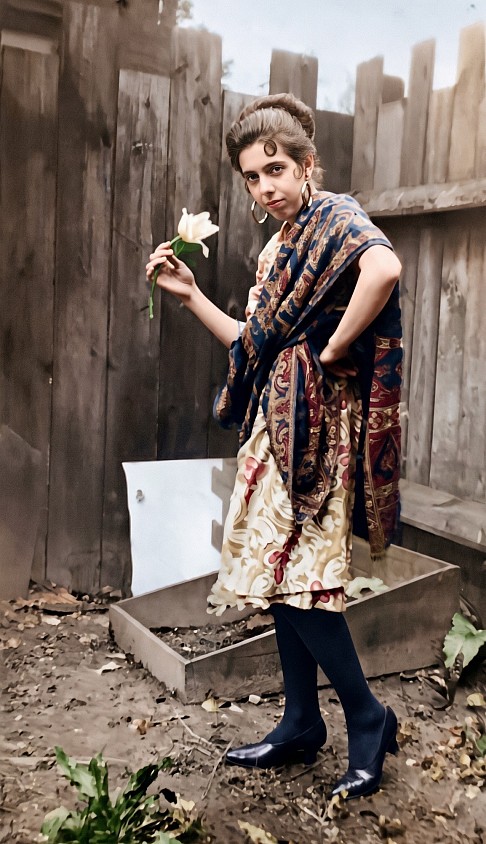
Marie's love shaped each of the children, especially the older boys and Kathleen. She gave them a sense of humor, encouraged their curiosity, inspired their creativity, and taught them that every job worth doing was worth doing well. Long before they understood those lessons, Marie was quietly building their character and a system of values, preparing them to become the parents, leaders, and people that would stand out one day, as they did! Marie's refused to let any one or anything spoil her day.
Then tragedy struck. While expecting their eighth child, Marie developed what first appeared to be a simple ear infection. By the time she gave birth to little Sheila, the infection had progressed to blood poisoning. Within days, Charlie lost both his newborn daughter and Marie, who was just thirty-eight years old.
Marie left no great fortune behind. Instead, she left a family whose greatest inheritance would be her love. And perhaps her greatest gift of all was one she never knew she was giving. She gave Charlie the strength, the example, and the foundation he would need to do what seemed impossible—to raise their family alone.